
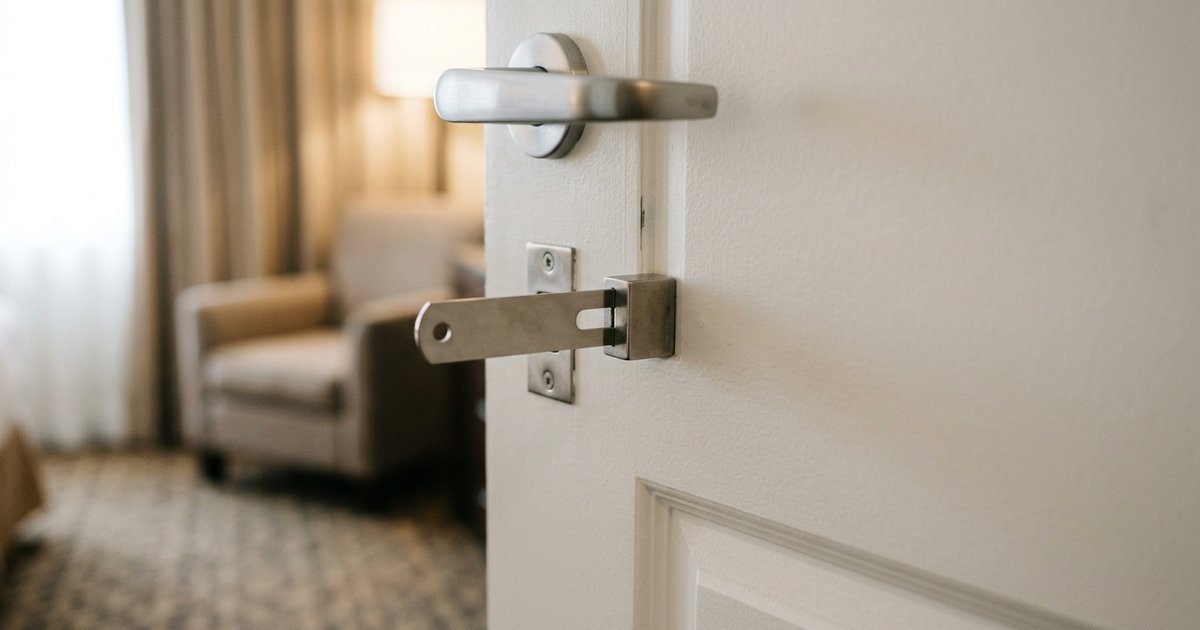
A portable door lock for a hotel is a small, tool-free device that you fit to the room door from the inside so the door cannot be opened even by someone with a key card or master key. A widely used style hooks into the strike plate on the door frame and blocks the door from swinging open. These locks work on single doors that swing inward into the room, and they only work while you are inside. They are inexpensive and quick to fit, but they do not make a door harder to kick in, and you need to be able to remove one fast in an emergency.
Why travelers use portable door locks
A hotel room door is opened by key cards and master keys that you do not control. Housekeeping, maintenance and front desk staff can enter, and a mistakenly issued card is also possible. Built-in secondary locks such as a swing bar or privacy latch help, but they differ from property to property. A portable lock gives you one consistent extra layer that you bring with you. The same tool is useful in short-term rentals, dorm rooms that are often master-keyed, rented rooms with weak privacy locks, and at home in the period before locks can be rekeyed.
Types of portable door locks
| Type | How it works | Best for | Watch out for |
|---|---|---|---|
| Strike-plate lock | A metal tongue slides into the latch hole in the door frame's strike plate. With the door closed, a second piece slots onto the tongue on the inside and physically blocks the door from opening. | Stopping someone who has a key or key card | Relies on the same strike plate as the existing lock, so it adds no strength against forced entry; may not fit some mortise locks |
| Door jammer or wedge | Sits at the base of the door; pushing on the door drives it harder against the floor | Adding resistance at a second point on the door | Grip depends on the floor; may not hold well on carpet; rubber versions resist less than metal ones |
How strong is a strike-plate lock?
One locksmith's assessment describes the strike-plate type as roughly as strong as a residential deadbolt. The important caveat is that it braces against the same strike plate the hotel's own lock uses. If someone is trying to force the door rather than open it with a card, the screws holding that strike plate are the weak point, so the portable lock adds little. Its real value is stopping a door that someone can otherwise open legitimately.
Will it fit your hotel door?
Check these points before you buy, and again when you arrive:
- Swing direction. Strike-plate locks only work on doors that swing inward toward you. They will not work on outward-opening, sliding or double doors.
- Door thickness. Limits vary by model; check the product specifications rather than assuming a particular thickness will fit.
- Lock style and strike plate. Compatibility depends on the actual strike plate and frame. Some products or unusual/mortise-style hardware may not fit, so check the product instructions and test the door if possible.
- Gap at the frame. The tongue has to fit between the door edge and the frame. A very tight door may not leave room.
- Floor surface. Wedges and jammers grip best on hard floors. On thick carpet they may slide.
Because no single design fits every door, some travelers carry two different types, for example a strike-plate lock and a metal jammer, so one of them will usually work.
How to install a strike-plate lock
- Open the door and insert the metal tongue into the latch hole in the strike plate on the frame, with the plate facing into the room.
- Close the door so it pins the tongue in place.
- Slide the blocking piece onto the part of the tongue that sticks out on your side of the door until it sits snug against the door.
- Try to open the door normally. It should not move more than a fraction of an inch.
- Practice removing it a few times so you can do it quickly, by feel, in the dark.
Safety: fire and emergencies
The feature that makes a portable lock useful, keeping out people with keys, also keeps out hotel staff, paramedics and firefighters. That trade-off matters most if you have a medical emergency and cannot reach the door. If you have a health condition, consider whether a portable lock is right for you, or let someone know you are using one.
In a fire you need to get out quickly. Choose a design that comes off in one or two simple motions without a key or combination, keep it in the same place every time, and practice removing it before you go to sleep. Keep the hotel's room key near your bed, as the U.S. Fire Administration suggests.
The U.S. Fire Administration estimates about 3,900 hotel and motel fires a year, based on its 2014–2016 report. Its tips for guests are straightforward:
- Stay in hotels and motels that have hard-wired smoke alarms and an automatic fire sprinkler system in each guest room.
- Read the evacuation plan carefully.
- Find the two closest exits from your room.
- Count the number of doors between your room and the exits, so you can find them in the dark.
- Find the fire alarms on your floor.
For short-term rentals, USFA also recommends confirming that you can open all doors and windows that lead outside and that everyone knows two ways out of every room. A portable lock should never be the reason one of those exits is slow to open.
What to look for when buying
- Material. For jammers, one locksmith's review found aluminum versions resist more than rubber ones.
- Fit range. Look for stated compatibility with door thickness and lock types, and check that it suits inward-swinging doors.
- Quick release. Prefer designs that need no key, code or tools to remove.
- Size and weight. It should fit easily in a toiletry bag or jacket pocket so you actually pack it.
Flying with a portable door lock
A portable door lock is a security device, not a weapon, but security screening rules are applied item by item. If you plan to bring one in a carry-on bag, check the TSA's "What Can I Bring?" tool before your trip, and keep in mind that TSA says the final decision on any item rests with the officer at the checkpoint. If you are traveling internationally, check the rules of the countries you are flying from and to.
Other ways to secure a hotel room
- Use every built-in lock: the deadbolt and the swing bar or latch.
- Do not say your room number out loud at the front desk, and ask for a new key if staff announce it.
- Check that connecting doors to neighboring rooms are locked.
- Look through the peephole or call the front desk before opening the door to anyone you were not expecting.
- Use the in-room safe for passports and valuables, and keep the most important items with you.
A portable door lock is a simple, low-cost addition for travelers who want control over who can open their door. Pick a design that fits the doors you are likely to encounter, practice removing it, and pair it with basic fire-safety habits. For the official fire-safety guidance, see the U.S. Fire Administration's hotel and vacation rental fire safety page.