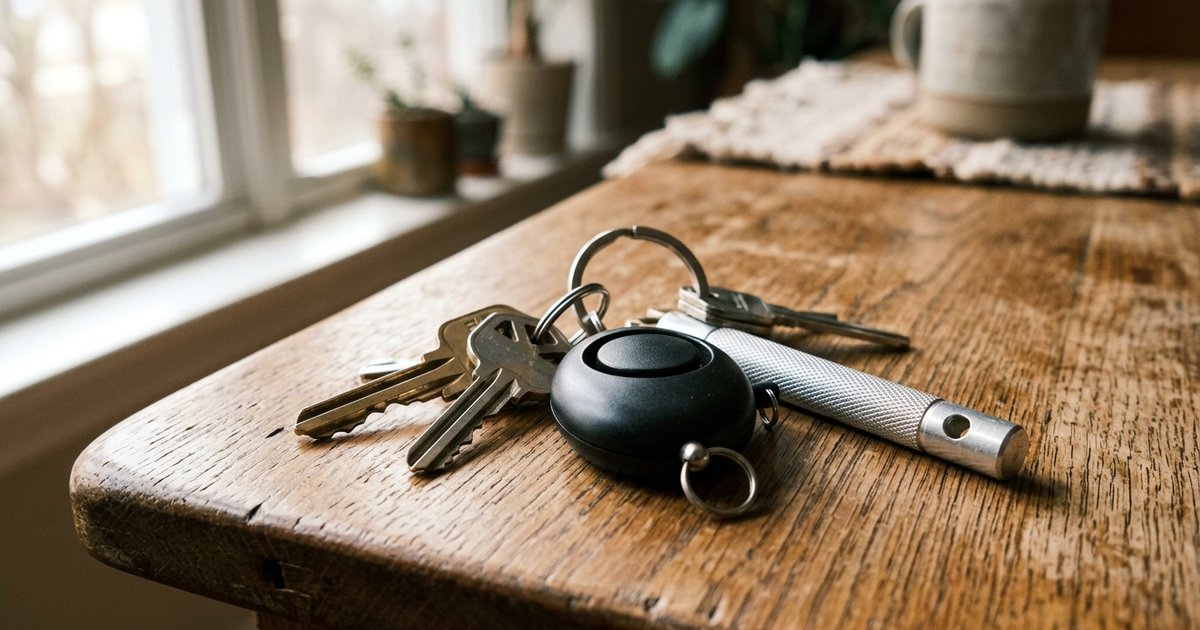
A self defense keychain is a small tool that rides on your key ring so it is in your hand when you walk to your car or front door. The common types are personal alarms, small pepper spray canisters, kubotan-style sticks, knuckle-style "cat ear" pieces, and compact stun devices. Which one makes sense depends on what you want it to do (draw attention, create distance, or strike), what is legal where you live and travel, and whether you fly often, because almost every type except an alarm is barred from carry-on bags.
Common types of self defense keychains
Most keychain kits combine two or three of the items below. It helps to judge each piece on its own.
| Type | What it does | Main limitations |
|---|---|---|
| Personal alarm | Makes a loud sound when you pull a pin or press a button, to draw attention and startle | Does nothing physical; only useful if people are nearby or the noise interrupts the person |
| Pepper spray canister | Irritates the eyes and airways to create time to get away | Wind, range and aim matter; canisters expire; legal limits on size and strength in some states |
| Kubotan (short rigid stick) | Concentrates force for strikes and pressure; also works as a key handle | Requires close contact and some training; treated as an offensive weapon in some places |
| Knuckle-style ("cat ear") keychain | Worn over the fingers to strike | May meet the legal definition of metal knuckles in some states |
| Mini stun device | Delivers an electric shock on contact | Requires contact; restricted or banned in some states and countries; battery maintenance |
| Glass breaker / multi-tool | Breaks a car window in an emergency; some include small blades | Blades raise legal and travel issues; mostly a vehicle safety tool |
Kubotans
Kubotans are short rigid keychain sticks, commonly made of hard plastic or metal, with grooves for grip and a ring for keys. Dimensions and construction vary by product. Some versions are hollow or hide a blade or spray, which can change how the law treats them; do not rely on an origin story or a generic size description when evaluating a particular item.
Pepper spray on a key ring
Keychain pepper sprays hold less spray than full-size canisters, so read the label for the stated spray range and number of bursts. Check the label for an expiration date and replace the canister when it passes. If you can, practice with an inert trainer canister so you know how the safety lock and nozzle work before you need it.
Personal alarms
An alarm is the least likely item to cause legal or travel problems. It works best in places where other people can hear it, such as parking lots, apartment hallways and campuses. Test it on a schedule and replace the battery as the maker recommends.
Are self defense keychains legal?
There is no single answer. Laws differ by state, by city and by country, and they cover different things: who may buy or carry an item, how big or strong it can be, where it can be carried, and when using it is justified. A few examples show how much the details vary.
- California pepper spray limits. California Penal Code section 22810 allows tear gas weapons, which California treats as including pepper spray, for self-defense only. It bars weapons that contain more than 2.5 ounces net weight of aerosol spray, bars minors from buying or possessing them, although California Penal Code section 22815 provides a limited exception for a minor age 16 or older when a parent or guardian is present or has given written consent. It also bars people convicted of a felony or an assault crime. Using one for anything other than self-defense is a crime.
- California metal knuckles. California Penal Code section 16920 defines "metal knuckles" as any device made wholly or partially of metal that is worn in or on the hand for offense or defense and that protects the hand while striking or increases the force of a blow. Possession is prohibited under section 21810. A metal knuckle-style keychain can fall inside that definition.
- New York pepper spray sales. Under New York Penal Law section 265.20, self-defense sprays may be sold only by licensed or authorized dealers and pharmacists, and possession by anyone under 18 or anyone convicted of a felony or assault is prohibited. A bill to loosen the sales rules (A1838C/S4922C) passed both houses on May 29, 2026, but the New York Senate bill page showed no gubernatorial signature, veto, or chapter number as of October 1, 2026. The current law therefore remains the one to follow unless the state records a later action; check the current bill page before relying on either version.
- Outside the United States. Some countries treat kubotans, sprays or stun devices as prohibited or offensive weapons. In the United Kingdom and Ireland, weapon classifications can depend on the item and circumstances; a generic product description is not a legal determination. Check the current law before carrying a kubotan or any hollow or spiked version.
These are examples, not a complete list. Before you buy or carry any self defense keychain, read your state and local law, check the rules of your workplace, school or campus, and look up the laws of any place you travel to. If you are unsure, a local attorney or your local police department's non-emergency line can point you to the relevant rules.
Can you take a self defense keychain on a plane?
In the United States, the TSA does not allow most self-defense items in carry-on bags. Its "What Can I Bring?" listings say:
- Kubotans: not allowed in carry-on bags; allowed in checked bags.
- Brass knuckles: not allowed in carry-on bags; allowed in checked bags, though TSA notes they are still illegal in some states and says that if a checked bag is opened and contains a prohibited item, it is required to report it to local law enforcement.
- Self-defense sprays: not allowed in carry-on bags. One container of mace or pepper spray up to 4 fl. oz. (118 ml) is allowed in checked baggage if it has a safety mechanism to prevent accidental discharge, and sprays with more than 2 percent by mass of tear gas (CS or CN) are prohibited even in checked bags. TSA also suggests checking with your airline, since some do not allow it.
- Stun guns and shocking devices: not allowed in carry-on bags; allowed in checked bags if packed so they cannot discharge accidentally. Some contain lithium batteries, which have their own rules.
The TSA officer at the checkpoint has the final say. If you fly often, a practical approach is to keep your self-defense items on a detachable ring that you can unclip and pack in your checked bag, or leave at home, and keep only your keys and an alarm on the main ring. Remember that an item allowed in checked luggage may still be illegal at your destination.
How to choose a self defense keychain
- Start with the law where you live and travel. Rule out anything that is restricted where you spend most of your time.
- Decide what the tool is for. An alarm calls for help, a spray creates distance, and impact tools only work at arm's length. Many people pair an alarm with one other item.
- Check how fast you can use it. You should be able to find and operate it by feel, in the dark, with the hand you would actually use. Safety caps and locks should be easy for you but hard to trigger by accident in a pocket or bag.
- Look at build quality. Check the split ring and clip, since a weak attachment can fail when you pull on it. Look for a clear expiration date on sprays and clear battery instructions on alarms and stun devices.
- Consider weight and bulk. A tool you find annoying to carry is a tool you will leave at home.
- Plan for training. Impact tools in particular are much less useful without practice. A local self-defense class can teach you how to use one and, just as important, how to avoid and leave a situation.
Using it responsibly
A keychain tool is a backup, not a plan. Awareness, avoiding risky situations when you can, and getting away are the main goals. Self-defense laws generally allow force only when it is justified by an immediate threat, and using a spray or impact tool outside those limits can lead to criminal charges. If you ever use one, leave the area, call for help and report the incident to police.
Store spray canisters away from heat, such as a car dashboard in summer, and keep all self-defense items away from children. Replace expired sprays and dead batteries promptly so the tool works when you need it.
Quick checklist before you buy
- Is this item legal to buy and carry in my state, city and workplace?
- Will I fly with it? If so, can I detach it for checked bags or leave it home?
- Can I use it quickly with one hand, without looking?
- Does it have an expiration date or battery I need to track?
- Do I know how to use it, and do I know when the law allows me to?
For official, current details, see the TSA's "What Can I Bring?" listing for kubatons, the text of California Penal Code section 22810, and the status of New York's pepper spray bill A1838.